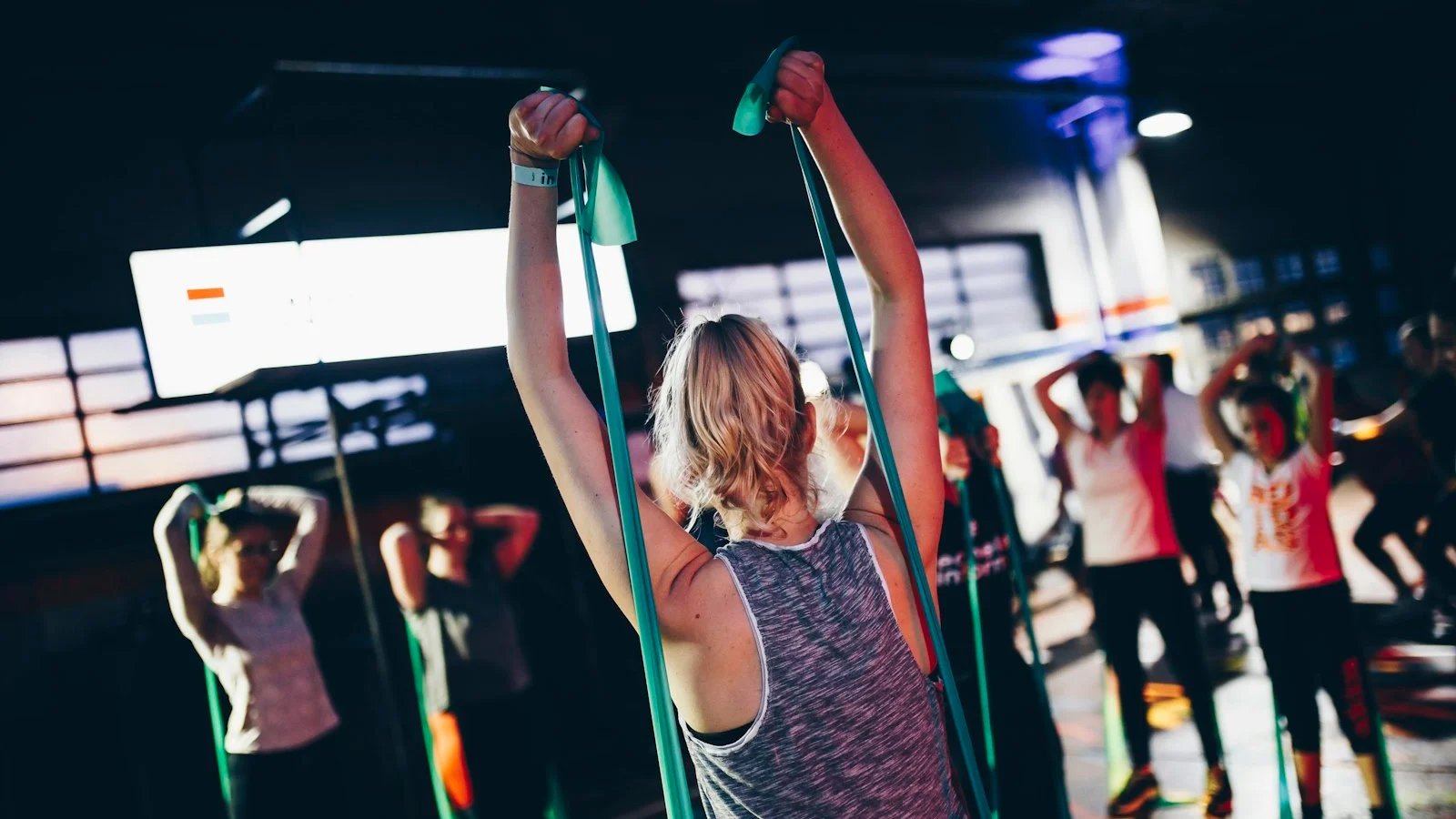

A superset is two exercises done back to back with little or no rest between them, then a rest before the next round. For coaches, supersets are the simplest way to fit a full session into less time: research shows clients do about the same amount of work, in a shorter session, with similar long-term results.
Key Takeaways
• A superset pairs two exercises with little rest between them; a tri-set uses three, a giant set four or more.
• A 2025 meta-analysis found supersets matched traditional sets for reps and volume, in a shorter session, with similar gains in strength and muscle.
• Supersets feel harder and cause more fatigue, so clients may need more recovery afterwards.
• Pair exercises that don't compete for the same muscles, and keep heavy main lifts as straight sets.
What is a superset?
In traditional training, a client does all the sets of one exercise, resting between each, before moving on. In a superset, the client does one set of exercise A, moves straight to one set of exercise B, then rests. That pair is one round, and the client repeats it for the planned number of rounds.
Two related terms come up often. A tri-set is three exercises done back to back, and a giant set is four or more. Both work like a superset, with more exercises in each round.
In a written program, supersets are usually labelled with a letter and a number. A1 and A2 are done together, then B1 and B2, and so on.
The five types of supersets
Not every pairing works the same way. The type you choose decides how much work a client can do in each round.
Type | How it works | Example | Best for |
|---|---|---|---|
Agonist–antagonist | Opposing muscles | Bench press and seated row | Saving time on main work |
Upper–lower | Different body regions | Split squat and push-up | Full-body sessions |
Same muscle (compound set) | Two exercises for one muscle | Dumbbell press and push-up | Extra fatigue in hypertrophy blocks |
Pre-exhaust | Isolation before compound | Leg extension and leg press | Bringing up a lagging muscle |
Tri-set or giant set | Three or more exercises | Lunge, row and plank | Conditioning and short sessions |
An agonist–antagonist superset is a pair that trains opposing muscles, such as the chest and upper back. While one muscle group works, the other rests, so performance holds up well from round to round.
What does the research say about supersets?
Time and volume. A 2025 meta-analysis of 19 studies and 313 participants compared supersets with traditional sets. Supersets produced a similar number of reps and similar volume load, in a shorter session (Zhang et al., 2025, Sports Medicine). Agonist–antagonist pairs allowed more reps than traditional sets, while pairs for the same muscle led to less volume load.
Long-term results. The same meta-analysis found similar gains in maximal strength, strength endurance and muscle size with supersets and traditional sets. A 10-week randomized trial is a useful caution. After a 3-week familiarization phase, adults did leg press, bench press, pulldowns and seated rows twice a week as supersets or as traditional sets. The superset group gained 5.2 kg less on the pulldown and slightly less on the seated row, but leg press, bench press and body composition improved about equally (Iversen et al., 2024, Journal of Strength and Conditioning Research).
Fatigue and effort. Supersets feel harder. The 2025 meta-analysis found higher blood lactate, a higher energy cost and higher ratings of effort than with traditional sets. In a crossover study of 14 men, superset and tri-set sessions raised a marker of muscle damage 24 hours later. Jump performance had not yet recovered by then, unlike after traditional sets (Weakley et al., 2017, European Journal of Applied Physiology).
The practical takeaway: supersets save time without costing results for most clients. Heavy strength work may progress a little better as straight sets, and clients need to recover from the extra fatigue.
When to use supersets with clients
Supersets suit:
- Time-poor clients, who can fit a full-body session into 40–45 minutes.
- Accessory work, where a little extra fatigue costs nothing.
- Hypertrophy blocks, where a same-muscle pair adds effort to each set.
- Busy gyms, as long as both exercises can be set up in one spot.
Use straight sets instead for:
- Heavy main lifts, where strength is the priority and rest helps performance.
- Clients learning a new movement, who need to focus on one technique at a time.
- The days after a hard session, when recovery is already stretched.
How to program supersets
Pick pairs that don't compete
For most clients, start with agonist–antagonist and upper–lower pairs. They keep performance high in both exercises. Save same-muscle supersets for hypertrophy work, where the extra fatigue is the point.
Set the rest
Rest little or not at all between the two exercises, then rest after each round. As a starting point, try 0–30 seconds between exercises and 60–120 seconds after the round. Lengthen the round rest for heavier pairs, and shorten it for accessories.
Adjust the effort target
Because supersets feel harder, a set that would be 2 reps in reserve as a straight set may land closer to 1. Ask clients to rate each set, and leave an extra rep in the tank on demanding pairs. If you're new to rating effort, read how to program reps in reserve.
Plan for recovery
Count supersets as harder sessions in the week. Avoid placing a heavy superset day right before a client's most important strength day. Schedule a deload week when fatigue builds up across a block.
Example: a 45-minute full-body superset session
Three supersets, three rounds each, with 90 seconds of rest after each round.
Superset A
- A1: Goblet squat, 8–10 reps at 2 RIR.
- A2: Chest-supported row, 10–12 reps at 2 RIR.
Superset B
- B1: Dumbbell bench press, 8–10 reps at 2 RIR.
- B2: Romanian deadlift, 8–10 reps at 2 RIR.
Superset C
- C1: Lateral raise, 12–15 reps at 1 RIR.
- C2: Cable curl, 12–15 reps at 1 RIR.
For clients chasing strength, keep the main lift as straight sets and superset the rest. This fits well inside daily undulating periodization, where each day has its own rep target.
How to build supersets in a coaching app
Supersets are hard to read in a spreadsheet or a notes app. Clients lose track of which exercise comes next and how long to rest. TrainBlock, launching in January 2027, lets you group exercises into supersets on your phone, with a rest after each round. You can also build circuits, intervals, AMRAPs and EMOMs, and assign the program to clients. Join the waitlist: the first 100 coaches get 6 months free.
Step by step: Supersets, circuits and other blocks in the TrainBlock Help Center.
Frequently asked questions
Do supersets build muscle?
Yes. A 2025 meta-analysis found similar muscle growth with supersets and traditional sets, as long as the total work is similar.
Are supersets good for strength?
They work, but heavy multi-joint lifts may progress a little better as straight sets. Keep the main lift as straight sets and superset the accessories.
How long should you rest between supersets?
Rest little or not at all between the two exercises, then about 60–120 seconds after each round. Rest longer for heavy pairs.
What's the difference between a superset and a circuit?
A superset pairs two exercises. A circuit runs through several exercises, usually four or more, before resting, and often targets the whole body.
Editorial note
Every study and official guideline cited in this guide was fact-checked against its original source on October 15, 2026.